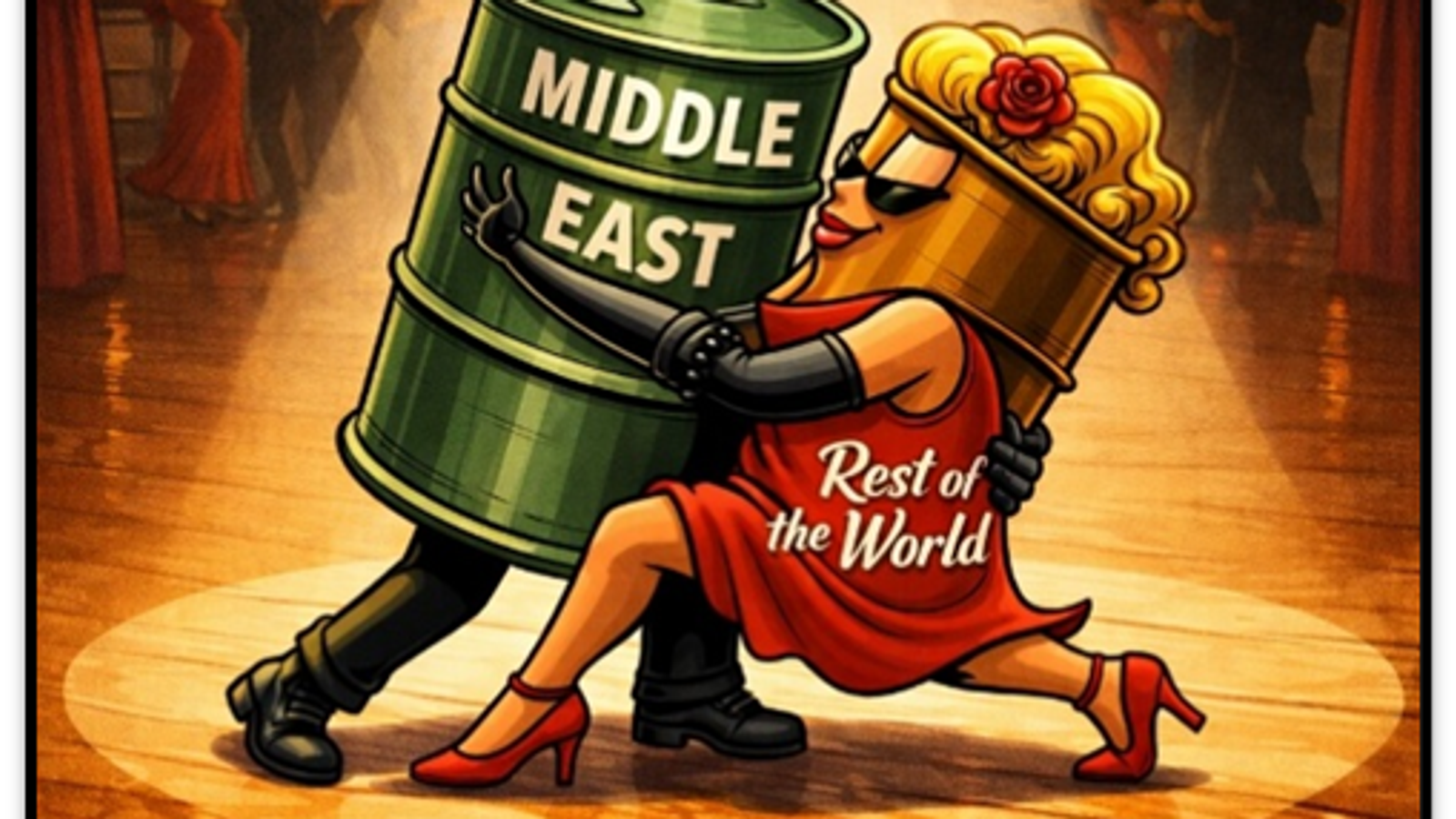
It Takes More Than One Barrel to Tango
From a Solo Performance to a Global Shuffle
For decades, the global oil market revolved around one region. One ballroom. One lead dancer. The Middle East set the rhythm. Everyone else followed. If something went wrong there, everything moved. Prices jumped. Tanker rates surged. The world reacted in sync. That reflex still exists.
You can see it right now. Tensions in the Strait of Hormuz and freight markets do what they always do. Rates spike. Not gently, but violently. Insurance follows. Routes get repriced overnight. The choreography is familiar, but the outcome is not. Because even now, the oil keeps moving. Not always from the same place. Not along the same routes. Not at the same cost. But it moves. It clears. It arrives. That is the difference.
Just months ago, the industry was having a completely different conversation. Surplus. Oversupply. Too many barrels. Analysts were calling for a market long by several million barrels per day in 2026.The concern was not disruption. It was excess. Then the script flipped. Again.
That is the first rule of oil. The balance never holds. The moment something looks settled, it’s not. And yet, even with a live geopolitical shock hitting the most sensitive chokepoint in the world, the system isn’t breaking because the map has changed.
The Middle East is still a powerhouse. That’s no secret. In normal conditions, it still accounts for nearly one-third of global oil production. It’s still relatively low in cost, still strategic, and still deeply relevant. But it is no longer singular.
Start with the United States, which remains the anchor of this shift. As of early 2026, U.S. crude production is running at roughly 13.5 to 13.8 million barrels per day, still the highest level ever recorded by any country. This is not marginal supply. This is structural dominance. Move north and the story continues. Canada is producing approximately 5.2 to 5.5 million barrels per day, supported by oil sands output and expanded takeaway capacity through projects like TMX.
Head south and the Atlantic Basin begins to reshape the map. Brazil is now producing roughly 3.8 to 4.2 million barrels per day, driven by its pre-salt offshore fields that continue to scale with remarkable consistency. Guyana, which barely registered in global supply a decade ago, is approaching ~900,000 barrels per day, with additional floating production units pushing it toward the million-barrel threshold. Even Venezuela, long constrained, is beginning to reintroduce barrels into the market.
Argentina is no longer theoretical either as Vaca Muerta has pushed production to roughly 800,000 to 850,000 barrels per day, with clear runway for export growth. Then there is West Africa. Nigeria alone is producing around 1.3 to 1.5 million barrels per day, with Angola and others contributing meaningful additional supply across the region.
These are not backup barrels. This is the system. And most of the world’s supply growth is coming from exactly these places. The market isn’t replacing the Middle East. It’s just not as tethered to it.
Supply is now less concentrated. It is distributed across continents, basins, and political systems. And distribution creates something the oil market never really had to this scale before: choice.
When flows tighten out of the Arabian Gulf, barrels don’t disappear. They reroute.US exports move. Brazilian cargoes lift. Guyana loads. West Africa fills gaps. The system flexes in real time. The chokepoint still matters. It just no longer decides everything. For decades, energy security meant access to the Middle East. Now it means access to options.
And that is a very different kind of power. Because the Middle East is still in the room. It’s just not the only one anyone is watching anymore.
The belle of the ball is still dancing. But it’s no longer dancing alone.