Strait Up With A Twist
Shaken by Risk, Consumed with Strategy
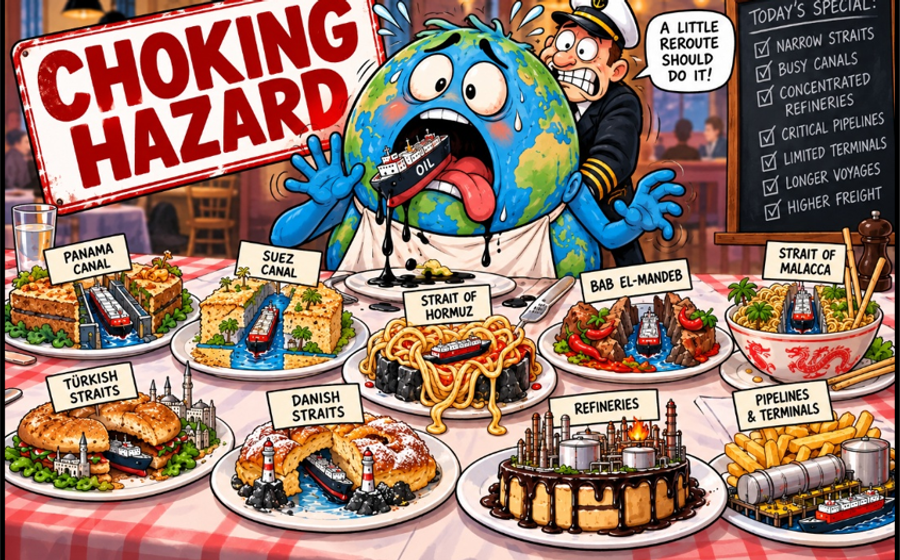
Over the weekend, the world was reminded that a narrow stretch of water can hold disproportionate power over the global economy. Oil is rising. Analysts continue to offer their version of implications of disruption in the Strait of Hormuz. Tanker rate projections started circulating almost immediately. The reaction was predictable. But the real story is not whether Hormuz closes. The real story is that governments and private companies alike are building a world where they do not have to care if it does.
For two decades, the oil and refined product trade was optimized for efficiency. Barrels moved along the shortest routes. Refining capacity concentrated where margins justified it. Storage remained lean. Capital rewarded optimization. The system worked because it assumed stability, or at least manageable instability. That assumption is severely eroding, and it has been for some time.
The latest escalation does not introduce geopolitical risk to the tanker market. It reinforces what the market has been learning since 2022 (and even long before that).Energy security now outranks efficiency. And when security becomes the priority, trade patterns change in ways that do not easily reverse.
Crude flows are already longer. Atlantic Basin barrels routinely move to Asia. U.S. exports act as a geopolitical shock absorber. Sanctioned cargoes travel circuitous routes. Every new flashpoint pushes governments and traders to ask a harder question. Who do we depend on, and how far away are they?
Refined products reveal the shift even more clearly. Crude is fungible. Diesel is political. Jet fuel is strategic. Gasoline shortages destabilize governments faster than crude price spikes. As tensions rise, nations are rethinking not only where crude originates, but where fuels are refined, stored, and sourced during crisis scenarios. That conversation does not disappear when the headlines do. This is how fragmentation becomes structural.
Diversification sounds cautious. In practice, it means distance. Friendly barrels are not always the closest. Politically aligned refining hubs are not always the cheapest. Redundancy requires duplication. Duplication requires ships.
We’ve already seen this shift in how risk lingers long after headlines fade. Even after Houthi attacks seemingly paused under a ceasefire earlier this year, many Owners still opted to go the long way around. It is the same question that surfaces in cocktail party conversations and conference corridors alike. What happens if Russian sanctions are eased or lifted entirely and Russian crude is once again available for everyone to transport? The assumption is that ships would rush back. The reality is more measured. Even if they do, it will take time before most Owners are willing to reenter those trades. Compliance scars remain. Insurance relationships matter. Financing covenants linger. Reputation risk does not reset overnight. Prudence, once learned the hard way, becomes policy inside companies. In shipping, memory is long and risk tolerance rarely rebounds as quickly as markets do.
The next phase of oil and product transportation may be defined less by sudden disruption and more by deliberate inefficiency. That inefficiency is not a market failure. It’s a decision. Geopolitical risk is being built into the structure of global energy flows. Charterers are prioritizing optionality, while Owners are prioritizing flexibility and investors are weighing alignment alongside demand.
Here is the uncomfortable truth. Shipping benefits from fragmentation. Not from conflict itself, but from the structural response to it. Longer hauls. Diversified sourcing. Parallel supply chains. Inventory buffers. Politically vetted trade routes. Each layer adds friction. Each layer adds ton miles.
The Strait of Hormuz may never “officially” close. It does not have to. Its existence as a chokepoint is enough to justify contingency planning, rerouting, storage builds, and supply realignment. There are pipelines designed to bypass Hormuz, but they absorb only a fraction of the volumes that typically move through it. They reduce exposure. They do not eliminate it. Risk, once viewed as episodic, is now being priced as a given.
Freight rates have risen and will most likely continue to in the coming days. But, war risk premiums will adjust. Markets will overreact and then recalibrate. The deeper shift, however, is unlikely to reverse. The oil trade, which was once optimized for globalization, is now being redesigned for resilience. And resilience travels farther.